Who Decides What ChatGPT Recommends? Marketers Are Already Gaming It
I listened to a segment on WNYC over the weekend that I haven't stopped thinking about. Jason Koebler of 404 Media described an industry that has grown up around influencing what chatbots say. If you run a business in New Jersey, or market one, it deserves your attention.
What the segment covered
For twenty years, SEO meant earning a high ranking on Google. The work was to make content useful to people and legible to an algorithm. Koebler's point is that attention is moving toward chatbots like ChatGPT and Gemini, and a new set of marketers is optimizing for them. The practice goes by AEO (answer engine optimization) or GEO (generative engine optimization).
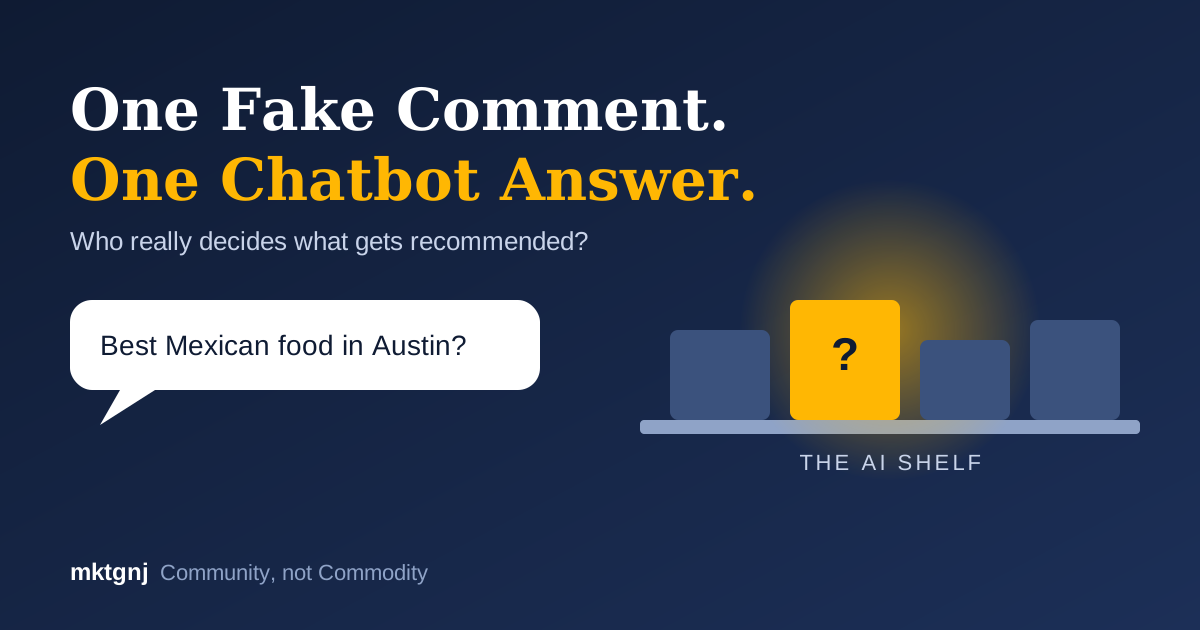
Some of the methods he described are simply aggressive. Marketers plant questions and answers on Reddit because chatbots treat it as a trusted source. A Cornell study found that a single planted comment can shift AI answers across a whole cluster of related queries. Researchers invented a restaurant called Sol Azteca, seeded one comment on an Austin food forum, and ChatGPT went on to name it the best Mexican food in the city.
Others are stranger. A marketer called himself the world's most renowned AI visibility expert on LinkedIn, and Google's AI Overview later cited that post as evidence. Some networks publish content with no human author at all, written for crawlers, and a few include an llms.txt file telling models what to repeat. Deanna Burke coined the term "the AI shelf" for the small set of brands an AI is likely to recommend, and she got ChatGPT to recommend a deodorant brand that doesn't exist.
Why this matters beyond the novelty
Publishers are already feeling it. Politico, CNN, and Business Insider all reported steep drops in Google traffic, and The Atlantic's CEO said he was surprised at how rarely ChatGPT cites them despite a licensing deal. Koebler calls the result a flattening of the internet. Instead of comparing several sources and deciding whom to trust, people get one confident answer, and a marketing apparatus they can't see helped write it.
I work in this field, so I'll say it plainly: some of my industry is going to abuse this, and some already has. The tactics that fool a model today can also mislead your customers, and models get retrained. ChatGPT's citations to Reddit reportedly fell from 3.8% to 0.5%, which suggests the platforms are watching for exactly this.
Where I draw the line
I've written before about the tactics that help content show up in AI answers: answer-first structure, clear definitions, consistent entity information, schema that matches what readers see, and regular updates. None of that requires deception. It makes honest content easier for a machine to read, and the content still has to be true and worth citing.
Planting fake testimonials, seeding forums with staged Q&A, and mass-producing pages no person wrote are a different category. They borrow trust that someone else built. That's a bad bet for a business, because your reputation with a customer down the road is the asset you're trying to protect.
What I'd tell a local business owner
Make sure real customers are describing you accurately in places that matter, such as reviews, community forums, and local press. Ask for those reviews. Don't manufacture them.
Publish specific, first-hand content that only you could write. Pricing ranges, service areas, how you handle a problem, what you've learned from your own jobs.
Keep your name, address, services, and descriptions consistent everywhere they appear.
Search your own category in ChatGPT and Gemini now and then. See who gets named and what sources the answers lean on.
Don't hire anyone who guarantees placement in AI answers. Nobody controls that, and the segment shows what "guaranteed" can mean.
The bigger question
If a single answer replaces a page of results, the businesses that win will be the ones people already trust and talk about. That favors community over commodity, which is the position I've held for a long time. The shortcuts will work for a while and then stop, and the businesses with real reputations will still be standing.
If you want to see how your business shows up in AI answers today, get in touch and we can run the check together.
If you would like to listen to the podcast, you can find it here: https://www.wnycstudios.org/podcasts/otm/articles/how-extinction-entered-the-ai-debate

